

What do you know about rest?
Something becomes possible when we stop

tl;dr: Rest is not only recovery; it is revelation. A week of intentional rest left me restored, but also brought me into contact with what constant motion had been helping me avoid.
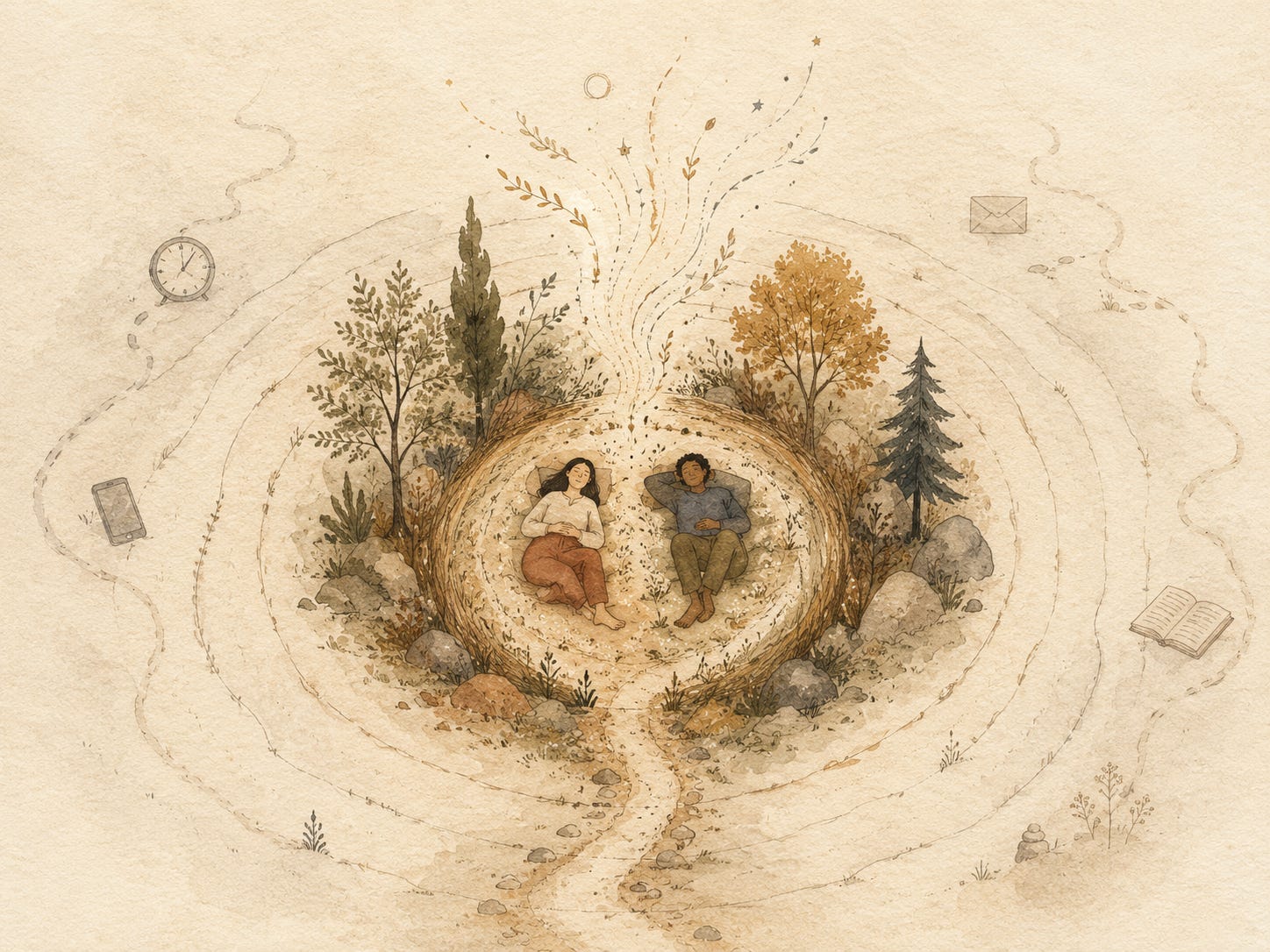
What do you know about rest?
I can start by telling you that I know very little.
In fact, when I’m tired, my first thought is:
“There is something wrong.”
I don’t tend to think:
“I am an animal, I am a mammal, I am organic life, and rest is something I need.”
And I definitely don’t jump to:
“I’m tired, good! I’ve been active. I’ve done good work. It’s time for me to rest!”
However! Tuesday (my wife and love of my life) and I are just coming back to work after our first ever “intentional week of rest.” Not a vacation full of activities. Not a retreat designed for spiritual growth and development. Just rest.
It went well. I feel rested, though definitely stirred up inside. And I’m not super excited about all the work, and the email and text replies, and the tasks and errands that lie before me. But it definitely went well.
Why did we do it?
I am becoming more and more keenly aware of how hard it is for me to stop. To just stop and not do. I am becoming aware that this is how anxious energy moves through me. I have long been aware that this pace is highly rewarded by our culture of productivity (and kept alive by the spectre of precarity.)
I have long gotten the message, (and yes, to me it comes as the voice of God), that if I slow down, and do less AND I take less input (less thought pieces, less podcasts, less audiobooks) I will do more of what God wants and get more of what I want.
The message could not be clearer. It has come many times and in many ways. At times it has felt like a drumbeat, as if spirit is trying to drill something in my head.
So I know what God wants. And I know what is good for me. And yet I can’t quite get myself to do it.
I have tried to bring compassion to this challenge. With Tuesday’s help, I have started to notice the uncomfortable energy that moves through my body when I stop. This is the sensation I am usually moving away from.
To be fair, I come by it honestly. Tuesday noticed this as soon as she met my parents (who are very special people, btw!). They are in their mid-seventies and neither of them seems to be slowing down (which might also be a good thing as you age… it’s complicated!)
But there is something here that merits our attention. Something about my pace, our pace, the pace of our culture, the pace of work, and even the pace of urgency among those trying to heal our world.
We have fallen under the industrial spell that we have to do a lot and that we have to do it fast.
What if what we are madly chasing after can be found by slowing down?
What if there is something essential that can only come to be known when we are in a state of rest?
Here I come back to Martha Beck, one of our favorite teachers. For Beck, rest is the first intervention. Meaning that whatever is going on, whether you are overwhelmed, or anxious, or stuck or unhappy, she will first recommend that you rest.
Rest is the first intervention because exhaustion interferes with self-knowledge. When we are depleted we tend to be led by the voices of fear, obligation, and cultural conditioning. Exhaustion leaves little room for our own inner knowing.
Beck’s work makes an important distinction between the social self, the self that is shaped by expectations, and the essential self, the self that orients towards what actually feels true, meaningful, and enlivening.
Rest quiets the pressure of the social self just enough for those subtler signals to become perceptible.
Martha Beck teaches that the essential self moves through a rhythm of rest and play.
Rest means genuine inactivity and receptivity.
Play means curiosity, creativity, and meaningful effort. When we have had enough rest, energy for action begins to return naturally. We are meant to play. We are called to meaningful effort.
Sometimes I think that if I give in to rest I will fall apart into an endless state of sloth, where all I can do is veg out, fall into bad habits, and stop taking care of myself.
This is where her contrast between the path of force and the path of harmony becomes important.
Force is very familiar to us. It says: push harder, override yourself, keep going.
Harmony begins with a different question: what is actually happening here? Does this body need restoration, or is it ready to engage?
The assertion is that when we force ourselves to work while depleted, we end up with poor judgment, resentment, and work that is often less effective than we imagine.
As a Gen Xer, I can feel some old alarm bells go off when the language of self-care begins to sound like an argument against difficulty and getting shit done. But Martha Beck is not arguing against hard work. Work that moves from our most authentic selves can be quite demanding. The distinction is between effort that feels internally coherent, effort that flows from our creative life force vs effort that is driven by fear and compulsion, the kind of effort that ends up in self-betrayal.
The point is that rest comes first, before any other intervention, because a depleted person cannot reliably distinguish intuition from anxiety, vocation from obligation, or meaningful effort from self-violence.
All of it sounds persuasive in theory. But Tuesday and I still had to figure out what a week of actual rest would look like.
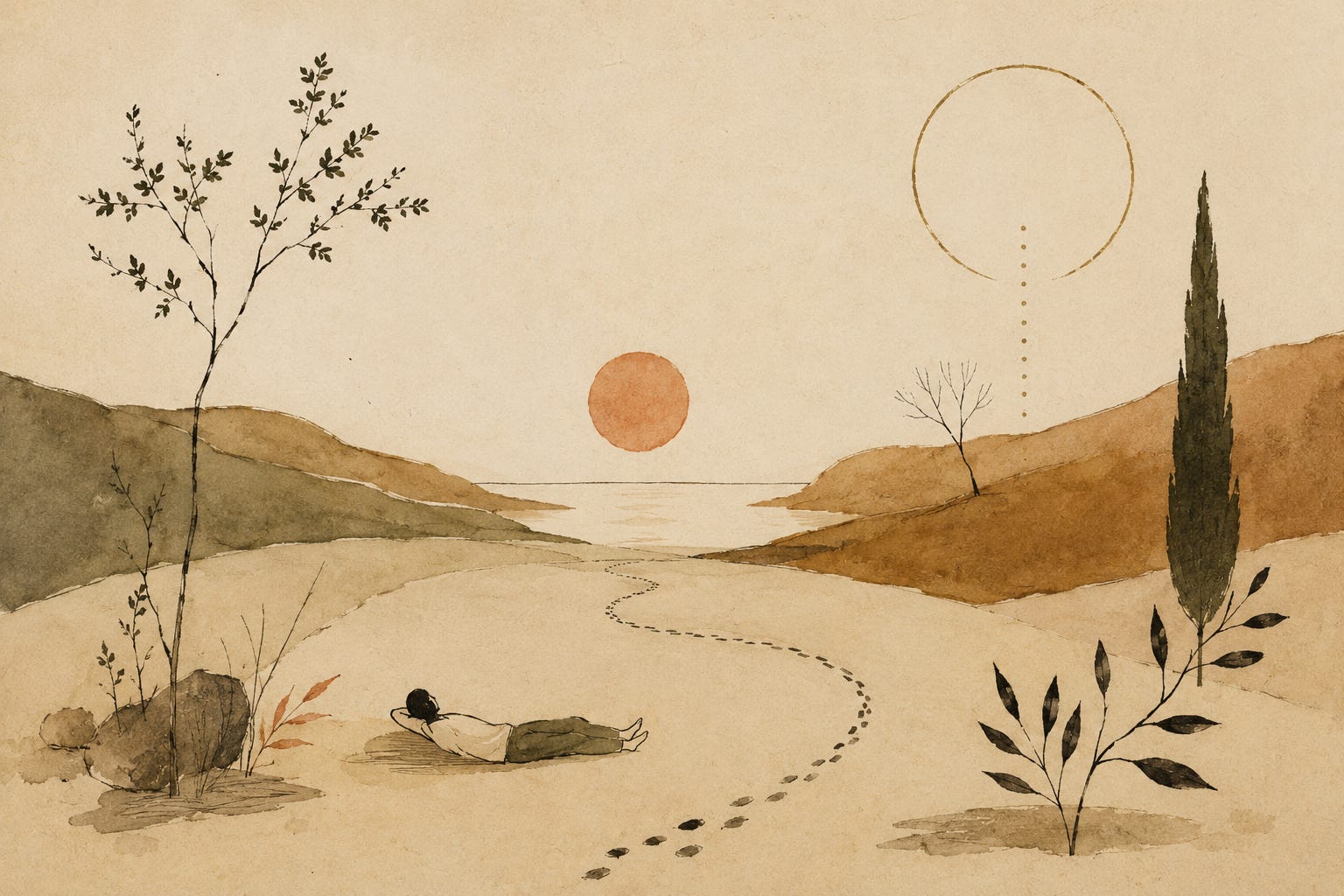
So, how did our week of rest go?
It was all just an idea until we finally did it. We had a set of basic principles to guide us. But we weren’t exactly clear on what it would look like in practice. You can imagine that parts of us thought this would be a great time to meditate and do yoga and exercise. You know, time to prioritize all of those essential things that, too often, feel like we have to squeeze into our busy lives.
Without even thinking about it, I began trying to turn rest into a self-improvement program.
Would this be a good time to work on a creative project? Martha Beck is a huge believer in creativity. But no, not if I turned it into another project. Creativity would be welcome only when it felt playful or restorative.
So, yeah. All kinds of questions.
Tuesday was pretty good about reminding us that the point is to do what we want when we want to do it. And not to do anything just because we think we should.
We knew we would be offline, and off the screen, but I knew I might just want to do some creative writing, just for the pleasure of it. So I got myself a writing journal. And I brought a paint-by-numbers kit (not at all normal for me) and my usual journal, and a whole bunch of books that I’ve been wanting to spend time with.
In the end, we did far less than we imagined. I meditated daily. Tuesday did some collaging. I may have written in my journal once. Mostly, we read. We took beautiful walks through the wilderness of Hocking Hills, Ohio. We ate simple healthy meals at the cabin.
We slept a lot. We stayed in bed even when we were not sleeping. We took naps. And we allowed ourselves some very lighthearted television at the end of the day.
Did taking a rest “work?”
It certainly did. It felt great. We returned to work more rested and more available. But the week also stirred something uncomfortable in me, and that is one of the important ways it worked.
I feel like the week gave me some insight into rest itself. I am getting a little better at letting go into shorter bouts of rest.
The discomfort of getting “stirred up” also matters. I am aware that one reason so many of us keep moving and doing is that we are turning away from an internal discomfort that needs our attention. I expected the discomfort to be strongest at the beginning, followed by a gradual surrender into rest. But it went the other way around instead.
It was towards the last couple of days that I started to sense something uncomfortable arising. I was careful not to turn even that into a project. I just sort of allowed it to be there in the background. At one point, I went into the woods by myself to walk silently with whatever was arising.
Things didn’t quite settle, a story of what was going on for me become particularly clear. But I am left with a somatic awareness that validates and supports the insight that there is something fruitful and necessary in slowing down and tuning in.
I wonder what would have happened if we had ten days instead of a week.
I am only starting to learn. But I am convinced that there is something transformational, and potentially revolutionary, about rest. I am also aware that the ability to take an intentional week away from work is a privilege many people do not have. That inequality should make us more serious about rest, not less. The conditions that deny people rest are themselves part of what needs to change.
Many of us who do have the privilege of choice are wearing ourselves out to keep up with lifestyles that are well beyond what we actually need to live a good life.
I am committed to learning more about rest and to encouraging you to rest.
I am also committed to learning more about the power of slowing down. Which is connected to rest but they are not quite the same thing. Let’s hold on to that distinction. And we’ll talk about slowing down next week.
For now, this feels like a good time to take a little break.
Maybe even practice rest!
Beautifully said! I just finished running two land retreats and most everybody arrived like one of those little snow globes that has been shaken up! It seems to take about 4 days - with lots of intentional spaciousness, freedom from screens, and time on the land - before people start to settle!