

Let's Not Surrender Democracy
Democracy, voting rights, and the moment that we're in

tl;dr: The right to vote in the United States is under renewed threat. This moment asks two things of us: that we protect the franchise with everything we have, and that we prepare ourselves to carry the responsibilities of democracy if the system actually breaks.
Quick note before we start. Tuesday Rivera’s Luminosity Intensive launches next week. Here’s a link to her latest newsletter with a lovely short clip of my gorgeous wife extending the invitation.
There is something I have noticed about luminosity: it doesn’t announce itself. Often, it simply begins to leak through the cracks - in a moment of unexpected courage, in the truth you finally say out loud, in the feeling of being truly seen by another woman who is doing her own work.
Now back to our regularly scheduled programming.
Here, in the United States, we have never had a full democracy.
I myself was born a disenfranchised colonial subject. I am not under the illusion that we have ever lived our way into the freedom of participatory democracy.
Nevertheless, we live in a system that, in fits and starts, has tended to expand the franchise.
That expansion is no longer.
We are living through the most serious retraction of our voting rights since the victories of the Civil Rights Movement.
Imperfect, exclusive and cumbersome though it is, our democratic process has nevertheless allowed us to grow, vote and organize towards more democracy. But this is no longer working. The voting rights and election protection infrastructure that we have in place risks being overwhelmed by an all-front attack on our most basic right. The right to vote.
There are rising obstacles to voting. A metastasizing virus of disinformation. Actual violence and the threat of violence at the polls. Aggression against public servants charged with overseeing elections. And, of course, the dangerous refusal to accept election results.
One of the most consequential voting-rights cases moving through the courts right now is Louisiana v. Callais. It puts into question a central tenet of the Voting Rights Act of 1965. The part that requires states to draw election maps that do not dilute the political power of minority voters.
The Supreme Court’s decision will come down anytime now, and it will shape how the Voting Rights Act is enforced. My stepson, Zane Ryan-Hart, a young Black man who is about to graduate college with a degree in political science, helped me to see how allowing states to break-up majority-minority districts will reshape the electoral map for a generation.
And it will not be good for those who believe in freedom.
Pause for a moment and consider all of the things that “cannot happen here” that have already happened here. The last decade has broken norm after norm in our not always fair but otherwise stable system. We must take seriously the possibility of losing our power to fully participate in a democracy. And we must bring attention to both:
What can we do to protect our democracy under such adverse circumstances?
What will we do if our electoral power is taken off the map?
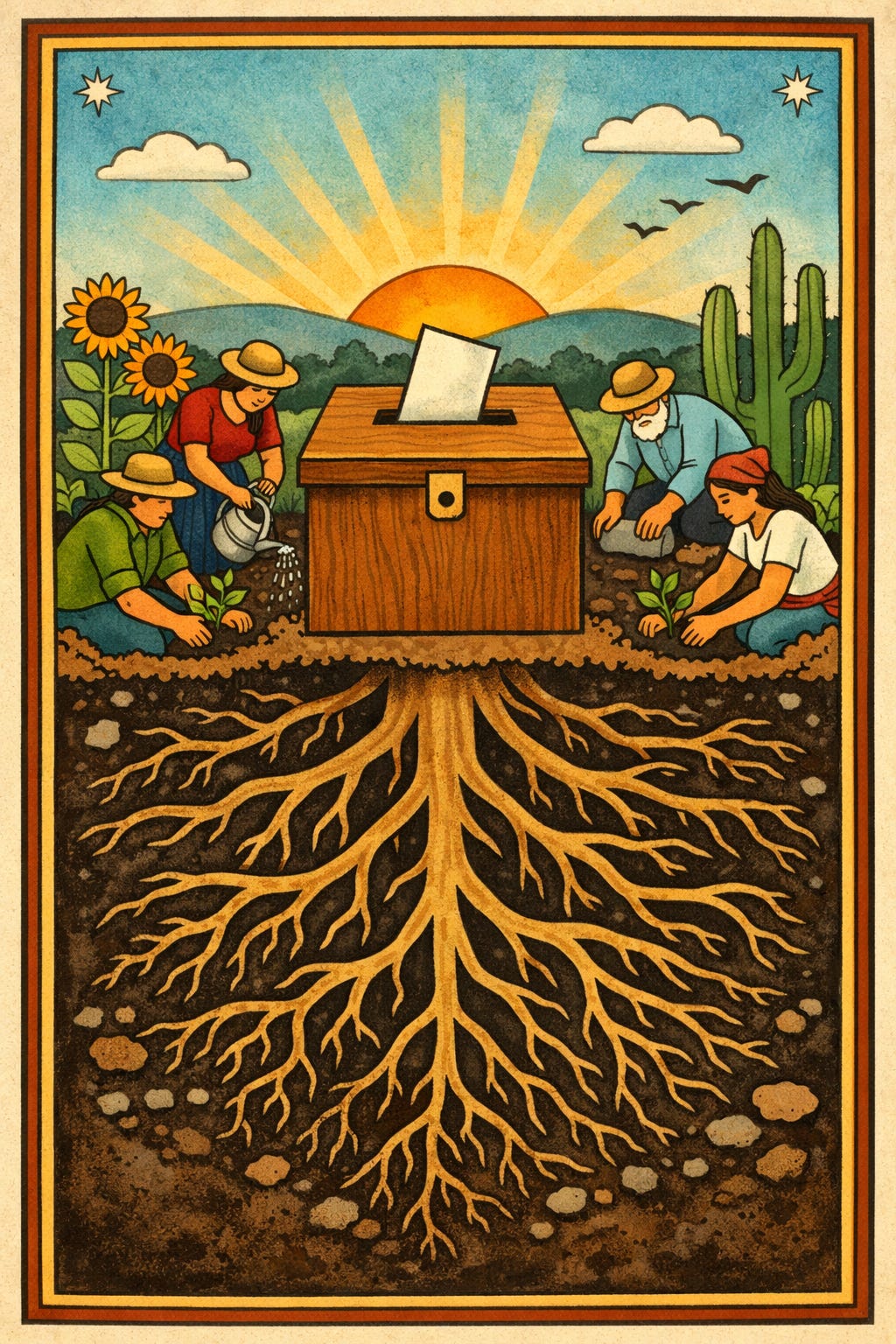
The answer to the first question begins with understanding how democracy is already being defended.
These are not abstract questions for me. Over the last eighteen months I have served as a consultant to a national effort to reimagine election protection, and I am just returning from facilitating a national voting rights convening. Those of us who are not “in the weeds” of the problem will have a hard time understanding how these processes work.
I can tell you that there is no centralized authority “in charge” of protecting our democracy. There is a decentralized ecosystem coordinated by a “coalition of the willing” that has been making remarkable, often unseen and uncelebrated efforts to safeguard the franchise.
We are not talking about well-resourced groups. I can attest that there is nobody “making money” here. These are people who care. Many have been at this for decades, others are younger people devoting their energy and life force to stand on behalf of us all.
I am certainly not connected to everyone working on this at the national level. So I encourage you to find out who is doing what in the places that matter most to you. Another option is to learn more from my friends at the State Infrastructure Fund, and consider giving of your time and resources to a group that they fund.
This is real. And the time is now.
What will we do if our electoral power is taken off the map?
This one is even harder to answer, but it demands our consideration. We have to be ready.
If our electoral power is weakened or taken off the map, the question before us will change. It will no longer be simply about how we vote. It will be about who we become as citizens. And more importantly, as a people.
For a long time, many of us have lived inside the assumption that the system would ultimately hold. That the arc of the law would keep bending toward greater participation. If that assumption fails, then democracy will have to live somewhere else for a time. It will have to live in the character, courage and discipline of ordinary people who refuse to surrender their freedom and the responsibility that comes with it.
If that moment comes, a few things will become necessary.
We will have to grow up politically.
Many Americans have lived inside a civic adolescence. We have assumed that our foundational institutions will maintain themselves, running unencumbered in the background.
As the franchise is weakened, citizenship will demand a higher level of maturity, vigilance and responsibility.
We will have to move from spectators to participants.
Democracy has never been sustained by voting alone. It depends on people who organize locally. These are the people who show up again and again to define a way of life that makes collective self-government possible.
We will have to practice disciplined, nonviolent resistance.
The Civil Rights Movement showed us what it looks like when people confront unjust laws and structures without surrendering their moral center. That tradition remains one of the most powerful resources available to us. It demands training. And spiritual development.
We will have to strengthen community and mutual responsibility.
Freedom is not something that any one of us possesses individually. Freedom lives in the commitments that we make to one another. Freedom finds roots in our willingness to stand together when the ground beneath us shifts.
We will have to refuse despair.
Despair is seductive in moments like this, but it is ultimately a form of surrender. The work of democratic life has always required patience, courage and a stubborn refusal to give up on the possibility of justice.
This is where we remember that we come from ancestors that have faced many apocalypses. This is where we remember the long view. This is where we remember that the seed of the next world is already here. In the darkness beneath the soil.
We have plenty of examples of the power of authoritarianism. It can grip nations for generations. There is no way to make light of what’s at stake. I never intend to be alarmist. My aim is to take a sober and clear-eyed view of life and its unfolding. My stance is the tragic optimism that Viktor Frankl taught us about: the capacity to affirm life and pursue meaning despite the inevitable presence of suffering, loss, and limitation.
If this dangerous trend continues, it is important to remember that democracy will not disappear overnight. It will retreat into the spaces where people continue to practice it. We practice it through solidarity, organization, moral courage and care for one another.
The question before us now is whether we are willing to become the people who must live into that responsibility.
Thanks for this excellent post Gibrán! I’m in Spain right now and often think about all of the things you’ve pointed out in your post, seeing the effects here on a nation that emerged from 40 years of dictatorship under Franco. The Spanish remain well aware of how dark that time was, and all of the creativity and focus on social justice that has emerged since Franco’s death in 1975. But the fascist detritus remains lying around in the political landscape, and is a good reminder that democracy is never settled for good, it’s a never ending need to maintain vigilance,solidarity and political awareness. I’m seeing that this fascist juggernaut is raising political awareness and resistance in people of all ages, and I’m putting a lot of faith and commitment toward the upcoming generations. Onward!